Furolog
Ganbanyoku: lying on hot stone, how to do it, and whether the Apple Watch comes along
岩盤浴 is a Japanese heat format that is not a sauna and not a bath: you lie on heated stone slabs in a 40°C room, dressed, for a long time. What it is, how a session goes, what it does to heart rate compared with a sauna, and what the watch makes of it.
Updated September 4, 2026
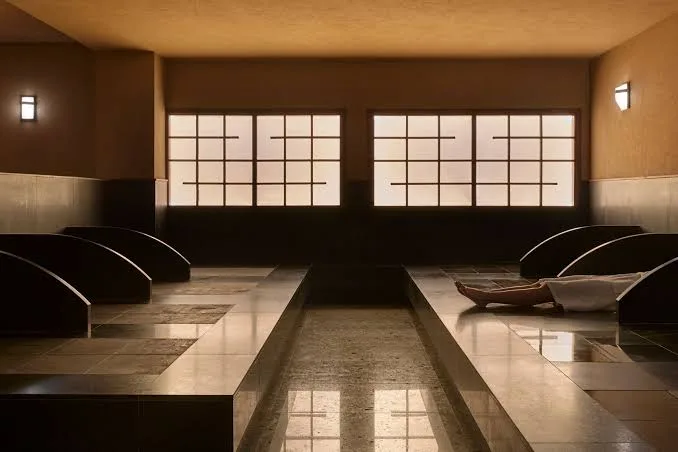
Ask a Japanese super sento what its most popular wing is and the answer is often not the baths or the sauna. It is the 岩盤浴, ganbanyoku, the room where people lie on heated stone for an hour in cotton pyjamas. It has almost no equivalent outside Japan, it is gentler than it sounds, and it raises an obvious question for anyone who tracks their sessions: is this a sauna, a bath, or something else, and does the watch come in?
The short answer: change into the facility's cotton outfit, lie face down on the stone for five to ten minutes and face up for ten to fifteen, cool off for five minutes with water, and repeat two or three times, 45 to 90 minutes in all. There is no cold plunge. The watch can come in, but the room typically sits above the 35°C ambient limit Apple publishes for every model except Ultra, so keep it off the slab, follow venue rules, and expect a heart rate chart rather than a water temperature one.
What it is
A ganbanyoku room is typically kept around 40 to 45°C with high humidity, 60 to 80% (facility values, not a standard), much milder than a sauna's 90°C. The floor, or a set of raised beds, is made of stone slabs heated from underneath: granite, basalt, or a named stone like Hokutolite or Bakuhan that facilities like to talk about. You lie on the stone on a thin mat, wearing the cotton top and trousers the facility gives you, and the heat comes from below, into the back, while the air around you is warm but breathable.
The mineral claims on the sign are marketing. The thing that works is the conduction: hot stone against the whole length of the body, for a long time, in a room where the air is not hot enough to make you leave.
How do you do ganbanyoku?
- Change into the ganbanyoku outfit. No swimwear, no underwear under it usually, and a large towel.
- Lie face down for five to ten minutes, then face up for ten to fifteen. The facility's sign will say something like this. Face down warms the abdomen; face up warms the back and lets you drift.
- Cool for five minutes in the rest room next door, which is kept cool and has water. Drink.
- Repeat two or three times. A whole session is 45 to 90 minutes, far longer than any sauna cycle.
- Sweat is the point. Ganbanyoku produces a lot of it, slowly, and the outfit is designed to be soaked. Wipe down with the towel, not the shower, if you want the "silky" post-session skin the facilities advertise. Shower afterwards if you prefer. Both are normal.
- No cold plunge. Some people go from the ganbanyoku to the sauna and the cold bath afterwards. As a ganbanyoku round itself, there is no cold phase, just the rest.
Etiquette is simple: silence, no phones on the stone, wipe your slab when you leave, and do not stay past the point where you feel dizzy standing up.
What it does to the body
Ganbanyoku uses lower ambient heat for a longer period than a typical high-temperature sauna. Heart rate may rise gradually, but the amount varies with temperature, posture, duration, and individual health. Mild heat over a long time does not necessarily add up to a big dose: a 2025 comparison of heating methods found that 45 minutes in a far-infrared cabin left core temperature essentially unchanged, while three 10 minute rounds at 80°C raised it by 0.4°C and 45 minutes in a 40.5°C bath by 1.1°C. Ganbanyoku itself was not tested, but it sits closer to the gentle end of that range than to the sauna. A Furolog chart can help you compare your own sessions; it cannot diagnose strain or prove a particular effect.
Some people find ganbanyoku gentler than a sauna, but prolonged heat and sweating still carry risks. Older bathers and people with heart or blood-pressure concerns should seek individual medical guidance. Stay hydrated and do not combine the session with alcohol.
The sweat is real and the dehydration with it. An hour on the stone loses a good deal of water, and the outfit is wet through by the end. Water before, between rounds, and after.
The Apple Watch question
Two parts.
Can you wear the watch? Apple says Apple Watch is designed to work in ambient temperatures of 0 to 35°C, and a ganbanyoku room is usually warmer than that; only Apple Watch Ultra carries a published on-wrist range up to 55°C. Apple also warns that ambient temperatures above 35°C can permanently damage battery capacity, and its water resistance page lists steam rooms among the places to avoid with every model, which a humid 45°C room is not far from. So operation and durability are not guaranteed. Keep the watch off the heated slab, stop using it if a temperature warning or abnormal behaviour appears, and follow any venue rule that prohibits electronics. See Apple Watch in the sauna for the broader heat guidance.
What does it record? There is no water, so the temperature sensor has nothing to read and Furolog will not log a bath segment. What it does log is the heart rate, and that is the useful part: a ganbanyoku session shows as a long, gentle climb with small dips at each rest, quite unlike the sharp peaks and cliffs of a sauna and cold plunge session. Record it as you would a sauna session, and the pattern of the rounds is easy to read afterwards. If you go to the sauna and the cold bath after the ganbanyoku, the chart shows both, and the contrast between the two kinds of heat is the clearest illustration of what a cold plunge actually does.
Ganbanyoku or sauna
Ganbanyoku when you want an hour of slow warmth, when you are tired, when you find the sauna oppressive, or when you want to sweat without a cold plunge. Sauna when you want the cycle, the cold, and the state at the end of it. The best afternoon at a super sento is often both, in that order, with the rest done properly after the sauna.
Read next: Half-body vs full-body bathing · Apple Watch in the sauna · Onsen vs sento: what is the difference
Sources
- Atencio JK, et al. "Comparison of thermoregulatory, cardiovascular, and immune responses to different passive heat therapy modalities." Am J Physiol Regul Integr Comp Physiol. 2025;329(1):R20-R35. https://doi.org/10.1152/ajpregu.00012.2025
- Apple Support. "Keep Apple Watch within acceptable operating temperatures." https://support.apple.com/en-us/108766
- Apple. "Batteries: Maximizing Performance." https://www.apple.com/batteries/maximizing-performance/
- Apple Support. "About Apple Watch water resistance." https://support.apple.com/en-us/109522
Quick answer
- Ganbanyoku: lying on heated stone in a 40 to 45°C humid room, dressed, for 45 to 90 minutes with short rests.
- Body: heat and sweating vary by person. Take breaks, drink according to thirst and venue guidance, and leave if you feel unwell.
- Watch: the room is usually above Apple's 35°C ambient limit for non-Ultra models; check venue rules and do not treat personal experience as a durability guarantee.
- Which: ganbanyoku for slow warmth, sauna for the cycle. Both, in that order, is the classic afternoon.