Furolog
Half-body vs full-body bathing: what changes in heart rate and temperature, and which one to use when
Half-body and full-body bathing differ in immersion depth, water pressure, and how quickly they feel warm. Compare practical timing, comfort, and heart-rate caveats.
Updated September 4, 2026
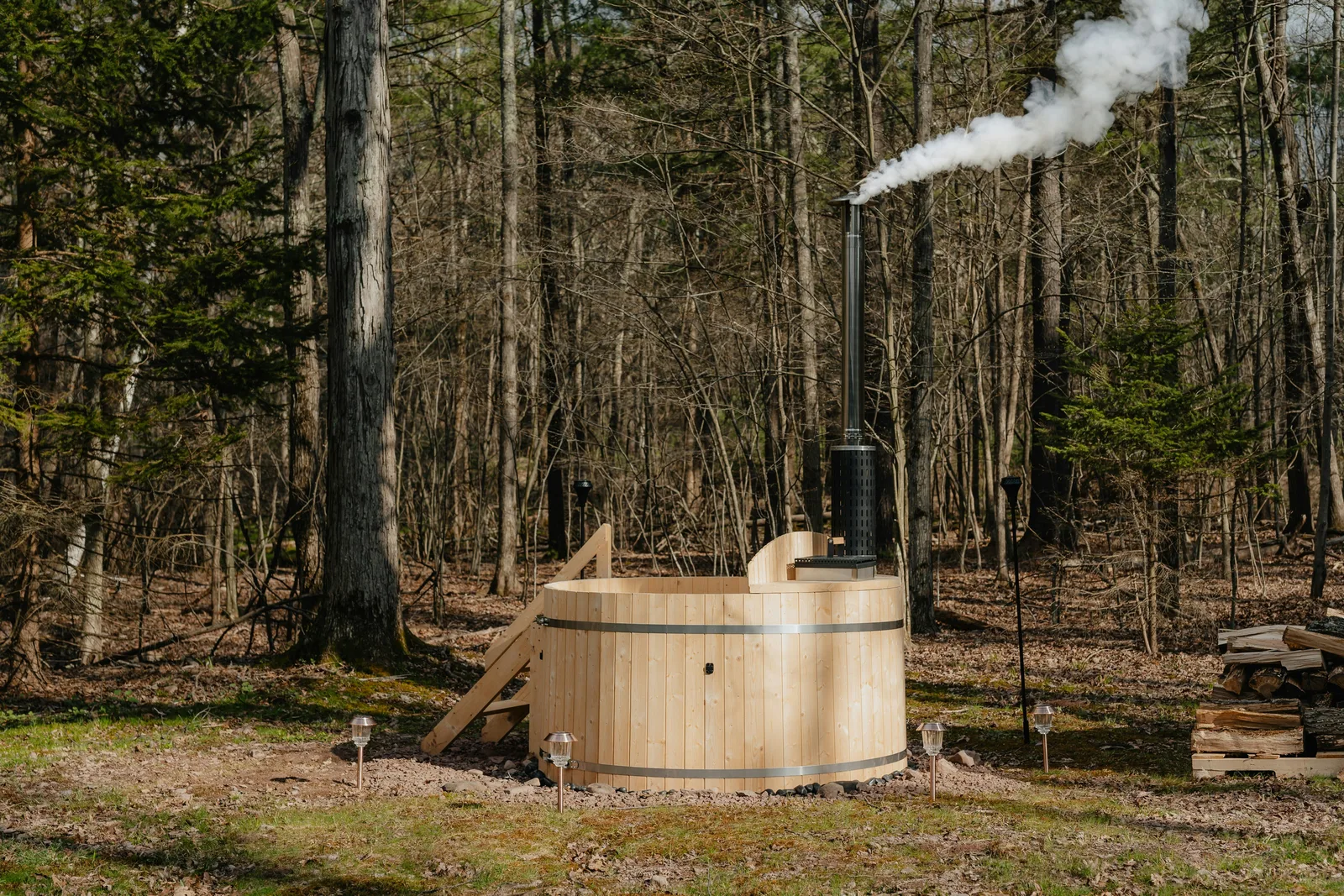
Japanese bathing has a word for sitting in the bath with the water at chest height, 半身浴, and it is treated as a different activity from the ordinary full bath, 全身浴, in to the shoulders. It is. The two differ in the one thing the body notices most, water pressure, and the difference shows up immediately on a heart rate chart.
A half-body bath is the gentler option: water to the chest at 38 to 40°C for 20 to 30 minutes, with no hydrostatic pressure on the chest and, in our sessions, only a small, slow rise in heart rate. A full-body bath at 40 to 42°C for 10 to 15 minutes warms you faster but adds water pressure on the chest to the heat load, and the research shows heart rate rising early at 41°C where it barely moves at 38°C. Choose half-body for a long, calm soak or the bath before bed, full-body when you are cold or short on time, and ask a clinician rather than assuming either is safe if you have a heart or blood pressure condition.
What water pressure does
In a full bath, the submerged body is exposed to hydrostatic pressure. Reviews of immersion physiology put the effect at roughly 700 mL of blood shifted from the legs into the chest, which raises the heart's filling pressure and stroke volume, and the pressure on the chest wall restricts breathing a little. Heat adds another source of strain: a Japanese study comparing 38°C and 41°C baths noted that Japanese-style bathing loads the chest with water pressure and heat at the same time, and at 41°C heart rate rose early and the vagal component of heart rate variability fell steadily, while at 38°C neither heart rate nor blood pressure changed significantly. So a hot, shoulder-deep bath may be harder to tolerate. Bathing is not a substitute for cardiovascular exercise, though habitual tub bathing is associated with lower cardiovascular risk in Japanese cohorts.
In a half-body bath, the chest and heart are above the water. There is no pressure on the chest, and the blood shift is much smaller. The heart is loaded by the heat alone.
What that looks like on a chart
| Half-body 半身浴 | Full-body 全身浴 | |
|---|---|---|
| Water | 38 to 40°C, to the chest | 40 to 42°C, to the shoulders |
| Time | 20 to 30 minutes | 10 to 15 minutes |
| Heart rate rise | Small and slow (in our sessions, roughly 5 to 15 bpm) | Larger and fast (in our sessions, roughly 15 to 35 bpm) |
| Core temperature | Rises slowly, similar total | Rises fast |
| Sweat | Plenty, over time | Plenty, quickly |
| Breathing | Normal | Slightly restricted |
| Feels | Long, gentle, sleepy | Short, strong, invigorating |
The temperature and time rows are common Japanese guidance. The heart rate rows are what we typically see in Furolog sessions, not study values; we have not found a trial that compares half-body and full-body bathing directly. What the research does show is the temperature effect: heart rate variability falls steadily as water temperature rises from 36 to 42°C, and cardiologists writing on hot spring bathing put the switch from a relaxing, parasympathetic response to a stimulating, sympathetic one at around 42°C.
A half-body session in Furolog is a long, low plateau: the heart rate drifts up a little over twenty minutes and mostly stays under the point where it would count as effort. A full-body session is the familiar sauna-shaped climb, compressed into ten minutes, and the drop afterwards is steeper because there was more to drop from.
The total heat dose ends up similar, since the half-body bath is warmer for longer, and that is the whole idea: the same warmth, without the load. Lying on heated stone in a 40°C room, ganbanyoku, produces the same long, low plateau over an even longer session.
Half-body or full-body bath: which should you choose?
Half-body bathing is for:
- People who find shoulder-deep immersion uncomfortable. A half-body bath may feel gentler, but anyone with a heart or blood-pressure condition should ask a clinician rather than treating it as automatically safe.
- Older bathers, for the same reason, and because the slower climb gives more warning. In a study of 1,479 older adults bathing at home, every 1°C rise in skin temperature during the bath came with about 3 bpm more pulse and 2.4 mmHg more systolic pressure, and a colder living room beforehand predicted a hotter bath. Japan's Consumer Affairs Agency guidance for older bathers is water no hotter than 41°C and no more than 10 minutes in it.
- The sleep bath. Twenty minutes at 39°C is a gentle way to get the core temperature rise that the 40°C rule relies on, without the stimulation of a hot full bath. A meta-analysis of 17 studies found that a warm bath or shower 1 to 2 hours before bed shortens the time it takes to fall asleep.
- During pregnancy, appropriate water temperature and duration depend on individual circumstances; ask your maternity care professional. For reference, a systematic review found that up to 20 minutes in a 40°C bath did not push core temperature past the 39°C threshold that matters for the fetus.
- Reading in the bath, which is the honest reason most people do it.
Full-body bathing is for:
- Being cold. A full bath warms the core faster than a half bath because far more skin is in the water; in a comparison of heating methods, 45 minutes shoulder-deep in a 40.5°C bath raised core temperature by 1.1°C, more than three 10 minute sauna rounds at 80°C.
- Muscle soreness, where the pressure itself helps circulation in the legs.
- Short on time.
- The onsen, where the bath is deep and the water is hot and a half-body soak means perching on a step. Do it anyway if you need to. Nobody minds.
Keeping the top half warm
The one problem with half-body bathing is that the shoulders get cold, especially in winter, and a chilled upper body with a warm lower body is uncomfortable and defeats the point. A towel over the shoulders, a warm bathroom, or a lid pulled across the far end of the bath all work. The Japanese half-body ritual often includes a bath lid drawn up to the chest for exactly this reason. Keep the room itself warm too: a review of Japanese-style bathing recommends dressing rooms and bathrooms at 20°C or more, and a few degrees warmer for older people.
Timing and the heart rate rule
The timings above are reference points, not universal limits. Furolog's alert at 75% of heart rate reserve is a product threshold, not a safe ceiling. Leave sooner if you feel dizzy, nauseated, breathless, or otherwise unwell. Sauna heart rate: what is normal explains the distinction.
Standing up is the moment to be careful after either, and more so after a full bath, where the release of the water pressure and the drop in blood pressure combine into orthostatic hypotension, a fall in pressure on standing that can put you on the floor. Sit up, wait, stand holding the edge. Heat shock in the bath explains why.
Read next: The 40°C, 90 minutes before bed rule · Heat shock in the bath · Onsen etiquette for first-timers
Sources
- Pendergast DR, Lundgren CEG. "The underwater environment: cardiopulmonary, thermal, and energetic demands." J Appl Physiol. 2009;106(1):276-283. https://doi.org/10.1152/japplphysiol.90984.2008
- Kataoka Y, Yoshida F. "The change of hemodynamics and heart rate variability on bathing by the gap of water temperature." Biomed Pharmacother. 2005;59(Suppl 1):S92-S99. https://doi.org/10.1016/s0753-3322(05)80016-2
- Ukai T, et al. "Habitual tub bathing and risks of incident coronary heart disease and stroke." Heart. 2020;106(10):732-737. https://doi.org/10.1136/heartjnl-2019-315752
- Xu J, Chen W. "Impact of water temperature on heart rate variability during bathing." Life (Basel). 2021;11(5):378. https://doi.org/10.3390/life11050378
- Ojima S, Ohishi M. "Effects of hot spring bathing on cardiac and vascular function." Hypertens Res. 2023;46:1705-1706. https://doi.org/10.1038/s41440-023-01290-2
- Tai Y, et al. "Blood pressure, pulse rate, and skin temperature during hot-water bathing in real-world settings among community-dwelling older adults: the HEIJO-KYO Study." Environ Health Prev Med. 2024;29:12. https://doi.org/10.1265/ehpm.23-00320
- Consumer Affairs Agency of Japan. "冬季に多発する高齢者の入浴中の事故に御注意ください!" News release, 19 Nov 2020. https://www.caa.go.jp/policies/policy/consumer_safety/caution/caution_042/
- Haghayegh S, et al. "Before-bedtime passive body heating by warm shower or bath to improve sleep: a systematic review and meta-analysis." Sleep Med Rev. 2019;46:124-135. https://doi.org/10.1016/j.smrv.2019.04.008
- Ravanelli N, et al. "Heat stress and fetal risk. Environmental limits for exercise and passive heat stress during pregnancy: a systematic review with best evidence synthesis." Br J Sports Med. 2019;53(13):799-805. https://doi.org/10.1136/bjsports-2017-097914
- Atencio JK, et al. "Comparison of thermoregulatory, cardiovascular, and immune responses to different passive heat therapy modalities." Am J Physiol Regul Integr Comp Physiol. 2025;329(1):R20-R35. https://doi.org/10.1152/ajpregu.00012.2025
- Tochihara Y. "A review of Japanese-style bathing: its demerits and merits." J Physiol Anthropol. 2022;41:5. https://doi.org/10.1186/s40101-022-00278-0
- Ringer M, Lappin SL. "Orthostatic Hypotension." StatPearls. https://www.ncbi.nlm.nih.gov/books/NBK448192/
Quick answer
- Half-body: water to the chest, 38 to 40°C, 20 to 30 minutes. Small, slow heart rate rise. No pressure on the chest.
- Full-body: to the shoulders, 40 to 42°C, 10 to 15 minutes. Larger, faster rise, plus water pressure on the heart.
- Choosing: people with medical conditions, pregnancy, or symptoms during bathing should seek individual guidance.
- Full-body for: being cold, sore legs, no time, the onsen.