Furolog
Onsen vs sento: what is actually the difference, and which one you want tonight
One is defined by a law about the water, the other by a law about the building. Price, water, atmosphere, and what each is good for, plus the third thing, the super sento, that most people actually mean.
Updated September 4, 2026
Both are places you pay to bathe naked with strangers, and from the inside they can look identical. The difference is in two laws, one about the water and one about the building, and once you know which law you are standing in, everything else about the place makes sense.
An onsen is defined by its water: under the Hot Spring Act it must come out of the ground at 25°C or above, or contain one of nineteen listed substances. A sento is defined by its role: a public bathhouse under the Public Bath Houses Act, usually filled with heated tap water, with an adult price fixed by each prefecture (600 yen in Tokyo from August 2026). A super sento is the large day-spa complex most people mean when they say "onsen" on a Sunday, and legally it can be either.
Onsen: defined by the water
An onsen is a hot spring, and in Japan that is a legal term. Under the Hot Spring Act, water counts as onsen if it comes out of the ground at 25°C or higher, or if it contains at least one of a list of nineteen dissolved substances above a threshold. Either condition is enough. This is why some famous onsen are cold at the source and heated for the bath, and why a facility in the middle of Tokyo can legitimately call itself an onsen if it drilled deep enough.
What you get: mineral water with a character, whether that is the sulfur smell of a mountain spring or the slippery feel of an alkaline one. The spring types post goes through what each feels like. Often an outdoor bath. Often a view. Prices from a few hundred yen at a municipal day-use bath to a few thousand at a ryokan, and the water is the point.
Sento: defined by the building
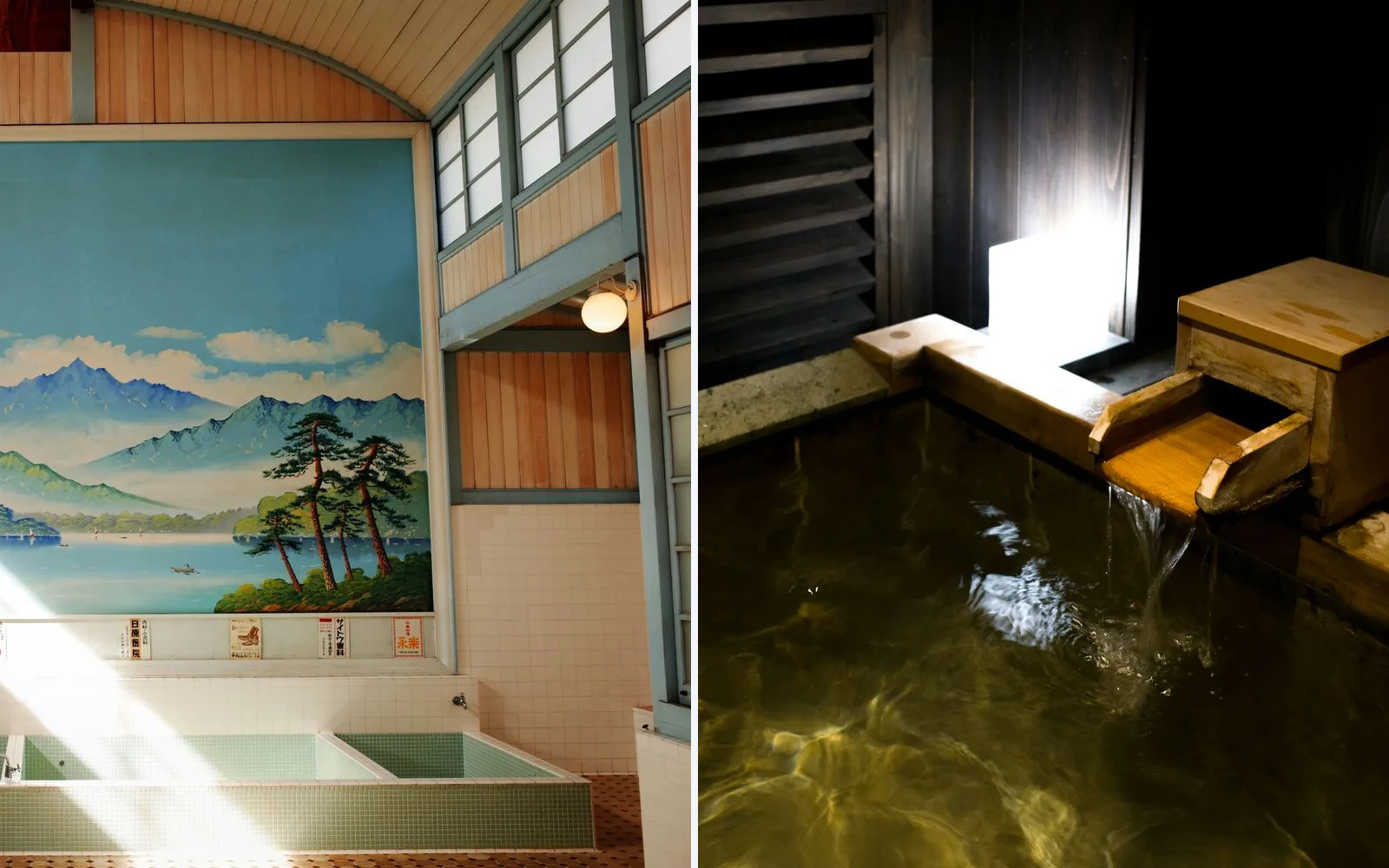
A sento is a public bathhouse, regulated under the Public Bath Houses Act as a piece of everyday infrastructure. The water is usually heated tap water, sometimes with additives, occasionally a real spring if the sento happens to sit on one. Prices are set by each prefecture; in Tokyo the adult fee is 600 yen from 1 August 2026, up from 550, and other prefectures set their own. The point is the neighbourhood: the tiled walls, the painted Mount Fuji, the regulars who have come every evening for forty years.
Sento are disappearing. Tokyo had 2,687 public bathhouses in 1968 and 444 in 2023, as home bath ownership went from 42% to nearly everyone. The ones that survive have often added a sauna and a good cold bath, which is why the 銭湯サウナ has become its own thing, and why the sento is where a lot of Japanese sauna culture actually happens.
The third thing: super sento
Most people who say "let's go to an onsen" on a Sunday mean a super sento: a large day-spa complex with a dozen baths, a sauna, a restaurant, a rest area with reclining chairs, and often a 岩盤浴 wing. Some are technically onsen because they truck in spring water or drilled a well. Some are technically sento. Legally it does not matter much to the visitor. Prices typically run from about 800 to 2,000 yen, and the point is a whole afternoon.
Onsen vs sento: what is the difference?
| Onsen | Sento | Super sento | |
|---|---|---|---|
| Defined by | The water (Hot Spring Act) | The building (Public Bath Houses Act) | Marketing |
| Water | Natural mineral spring | Heated tap water, sometimes more | Either |
| Price | 500 yen to several thousand | Prefecture-set; 600 in Tokyo from Aug 2026 | Typically 800 to 2,000 |
| Time | An hour, or a night | Half an hour | An afternoon |
| Best for | The water, the view, travel | The neighbourhood, a daily bath, sauna | Variety, a rest area, families |
| Tattoos | Often refused | Usually fine | Usually refused |
| Towel and soap | Provided at ryokan, otherwise bring | Bring or buy | Included or rented |
Which one you want
The water is the point: onsen. Go for the spring, not the building.
You want a bath tonight and live in a city: sento. Cheaper, closer, and the sauna is often better than you expect.
You want a whole afternoon, with a family or a group: super sento.
Tattoos: sento, or a private bath at an onsen.
Whichever you pick, the habit itself seems to be worth keeping. In the JPHC cohort of 30,076 Japanese adults, people who took a tub bath almost daily had a 28% lower risk of cardiovascular disease over roughly two decades than those who bathed twice a week or less.
What Furolog logs
Furolog logs the spring type of a session, so an onsen visit and a sento visit look different in your history even when the water was the same temperature. Spring type feeds the prefecture map and the spring-type stats. A sento with no natural spring simply logs as a bath. The etiquette for both is the same, and it is in onsen etiquette for first-timers.
Read next: Onsen etiquette for first-timers · Onsen spring types explained · Apple Watch in the bath and at the sento
Sources
- Hot Spring Act (温泉法), Act No. 125 of 1948. e-Gov.
- Ministry of the Environment, Japan. "温泉の定義" (Definition of onsen under the Hot Spring Act).
- Public Bath Houses Act (公衆浴場法), Act No. 139 of 1948. e-Gov.
- Tokyo Sento Association. "入浴料金統制額改定のお知らせとご理解を" 21 Jul 2026.
- Tokyo Metropolitan Government, 公衆浴場対策協議会 資料1. "都内公衆浴場数の推移及び入浴料金統制額の改定状況."
- Ukai T, et al. "Habitual tub bathing and risks of incident coronary heart disease and stroke." Heart. 2020;106(10):732-737.
Quick answer
- Onsen: natural spring water, 25°C at the source or one of nineteen minerals. The water is the point.
- Sento: a public bathhouse, price set by the prefecture (600 yen in Tokyo from August 2026), usually heated tap water. The neighbourhood is the point.
- Super sento: the big day-spa complex most people mean. Either, legally.
- Tonight: sento. Travelling: onsen. Sunday with family: super sento.