Furolog
The ten types of hot spring water in Japan, and what each one feels like
Japanese onsen are classified by what is dissolved in the water. Here is each official type, its typical temperature and feel, a famous example, and what it means for your skin, your watch, and your session log.
Updated September 4, 2026
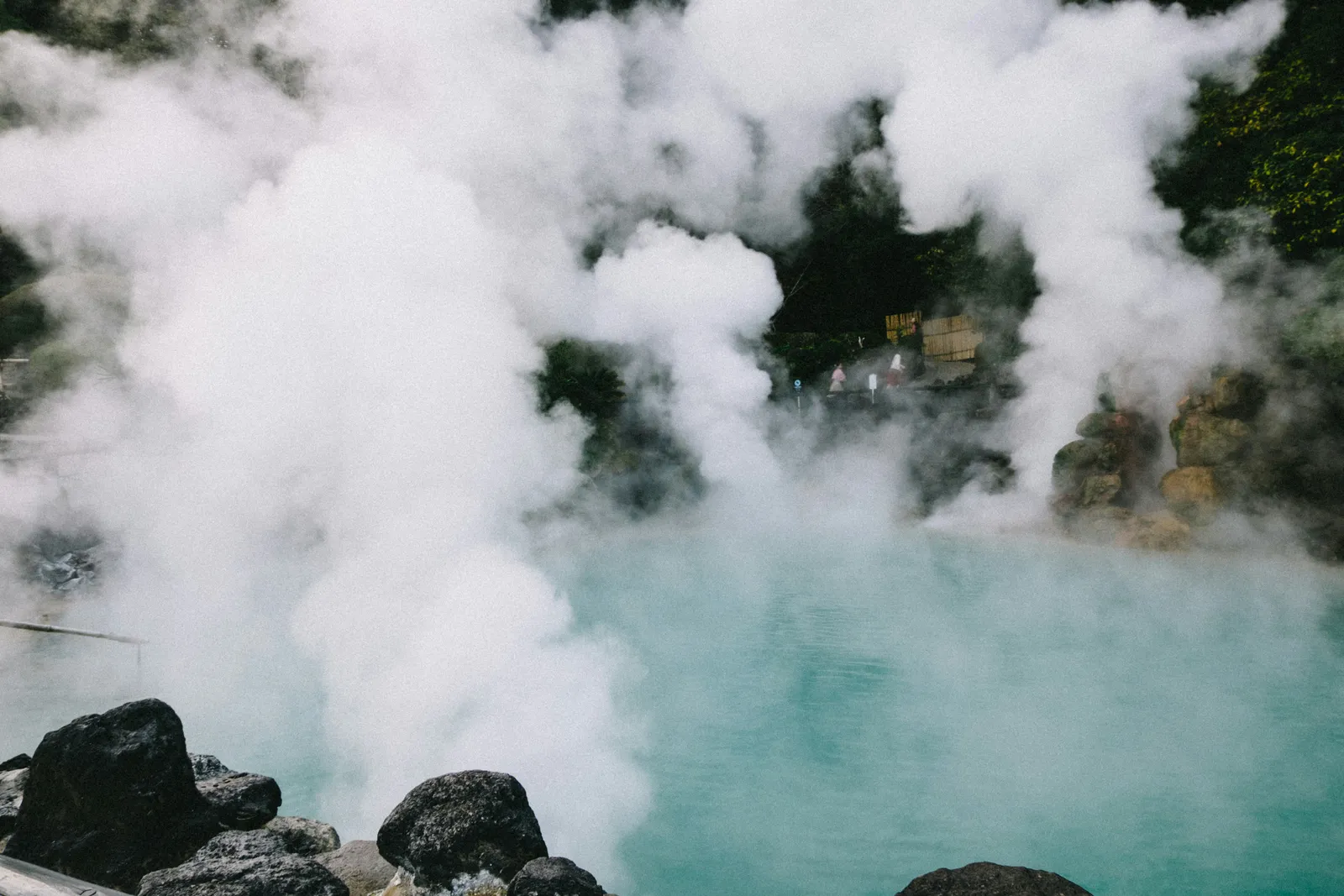
Every onsen in Japan posts a sign near the bath listing its 泉質, the spring quality. Most visitors walk past it. It is the single most useful thing in the building, because it tells you what the water will do to you, how hot it is likely to be, and, if you log your baths, what to write down.
Japan's Ministry of the Environment classifies therapeutic hot spring water (療養泉) into ten types by its dominant dissolved components: simple, chloride, bicarbonate, sulfate, carbon dioxide, iron, acidic, iodine, sulfur, and radioactive. The list has been ten since 2014, when iodine springs were added and two older categories were dropped. Simple and chloride springs are the most common; acidic and sulfur springs are the ones that feel and smell most different, and the ones to rinse a watch after.
How the classification works
Under Japan's Hot Spring Act, water counts as an onsen if it comes out of the ground at 25°C or above, or contains at least one of nineteen listed substances above a threshold. Springs that meet the stricter standard for therapeutic use (療養泉) are then classified by their dominant components into ten types under the Ministry of the Environment's analysis guidelines. A single spring can carry more than one label, which is why signs sometimes read like a chemistry exam: ナトリウム・カルシウム-塩化物・硫酸塩泉.
Furolog lets you tag each session with a spring type. The list in the app includes these ten plus a few common subtypes, so the classification below is the one you will use.
What are the 10 types of onsen water?
1. Simple spring (単純温泉)
Mineral content below 1 gram per kilogram of water, temperature 25°C or above at the source. Clear, odourless, gentle, and the most common type in Japan. If the pH is 8.5 or above it becomes an alkaline simple spring (アルカリ性単純温泉), which feels slippery and is marketed as good for skin.
Typical bath temperature 40 to 42°C. Good for beginners, children, and long sessions. Nothing to worry about for a watch. Famous examples: Gero, Dogo, Yufuin.
2. Chloride spring (塩化物泉)
Salt water, essentially. Often near the coast or from deep wells. The salt leaves a film on the skin that slows evaporation, so you stay warm long after you get out, which is why these are called "hot water of heat retention" (熱の湯).
Typical bath temperature 41 to 43°C. Feels slightly heavier than plain water. Rinse the watch and band afterwards; dried salt is the mineral most likely to corrode over time. Famous examples: Atami, Shirahama, Wakura.
3. Bicarbonate spring (炭酸水素塩泉)
Alkaline, with sodium or calcium bicarbonate. The water is noticeably slippery and softens the outer layer of skin, which is where the "beauty bath" (美人の湯) reputation comes from. Skin can feel dry afterwards, so many people rinse lightly.
Typical bath temperature 39 to 42°C. Famous examples: Ryujin, Kawanaka, Ureshino.
4. Sulfate spring (硫酸塩泉)
Contains sulfate salts of calcium, sodium, or magnesium. Slightly bitter to taste, mild on the skin, traditionally used for cuts and bruises. Often clear.
Typical bath temperature 40 to 42°C. No special watch concern. Famous examples: Hoshi, Yamashiro, Ikaho (as part of a mixed spring).
5. Carbon dioxide spring (二酸化炭素泉)
Carbonated water, with bubbles that form on your skin. The gas dilates blood vessels near the surface, so a 38°C carbonated bath can feel as warm as a 41°C plain one, and in our own sessions the heart rate response is often a little larger than the temperature alone would suggest. Usually cooler at the source, because heat drives the gas off.
Typical bath temperature 36 to 40°C. On a watch the bubbles can collect on the temperature sensor and nudge the reading slightly. Famous examples: Nagayu, Yunokawa (Hokkaido).
6. Iron spring (含鉄泉)
Iron-rich water that is clear at the source and turns reddish brown as the iron oxidises in air. Distinctive metallic smell. Traditionally recommended for anaemia.
Typical bath temperature 40 to 42°C. Will stain light-coloured fabric bands and towels. Famous examples: Arima (the Kinsen "gold spring"), Ikaho.
7. Acidic spring (酸性泉)
pH below 3, sometimes below 2. Sharp on the skin, stings cuts, strongly antibacterial, historically used for skin conditions. Not for long soaks and not for sensitive skin.
Typical bath temperature 40 to 45°C, and these are often among the hottest baths in the country. For a watch this is the one type to think twice about: acids are on Apple's list of substances to keep the watch away from. Rinse within a minute of leaving the water or leave the watch out. See can you wear an Apple Watch in an onsen. Famous examples: Kusatsu, Tamagawa, Zao.
8. Iodine spring (含よう素泉)
The newest category, added in the 2014 revision of the analysis guidelines, which also retired the old aluminium and copper-iron categories. Iodine-rich water, often yellowish, often from deep wells in areas that were once seabed. Mild feel.
Typical bath temperature 40 to 42°C. Rare. Famous examples: Shirako (Chiba), Aoyama Onsen (Tokyo).
9. Sulfur spring (硫黄泉)
The one you can smell from the car park. Hydrogen sulfide gives the rotten-egg odour and often a milky white or blue-green colour as it reacts with air. Softens skin, traditionally used for skin conditions and joint pain, and the smell stays on you for a day.
Typical bath temperature 40 to 43°C. Sulfur tarnishes silver, copper, and some coatings, and the smell lingers in fabric bands. Rinse the watch well and use a silicone or fluoroelastomer band. Famous examples: Noboribetsu, Nyuto, Manza, Kusatsu (which is both acidic and sulfurous).
10. Radioactive spring (放射能泉)
Contains trace radon. The levels are far below anything harmful and are traditionally believed to stimulate metabolism. Clear and unremarkable to the touch. Often on the cooler side.
Typical bath temperature 38 to 41°C. No watch concern. Famous examples: Misasa, Masutomi.
Temperature by type: what to expect
| Type | Typical bath temperature | Feel |
|---|---|---|
| Simple | 40 to 42°C | Gentle, clear |
| Chloride | 41 to 43°C | Warming, stays with you |
| Bicarbonate | 39 to 42°C | Slippery, softening |
| Sulfate | 40 to 42°C | Mild, slightly bitter |
| Carbon dioxide | 36 to 40°C | Cool water, warm feel, bubbles |
| Iron | 40 to 42°C | Metallic, rust-coloured |
| Acidic | 40 to 45°C | Sharp, stinging |
| Iodine | 40 to 42°C | Mild, yellowish |
| Sulfur | 40 to 43°C | Smell, milky, softening |
| Radioactive | 38 to 41°C | Unremarkable |
These are typical ranges from our own logs and facility signage, not official figures. Every bath is adjusted by the facility, and the outdoor bath is usually a degree or two cooler than the indoor one. Temperature also does more to your body than the spring type does: a 2023 commentary in Hypertension Research puts the switch from a relaxing bath (parasympathetic activity, blood pressure falling) to a stimulating one (sympathetic activity, blood pressure and heart rate rising) at about 42°C.
Why log the type
Once you have a few dozen sessions tagged, patterns show up that you would not have guessed. In our own logs, carbonated baths produce a heart rate response out of proportion to their temperature, sulfur springs tend to be the ones we stay in longest, and chloride baths show the slowest cool-down after getting out. Furolog's per-spring-type statistics are built for exactly this, and the prefecture map fills in as you go, since spring types cluster by region: sulfur in the volcanic north, chloride along the coasts, bicarbonate in Kyushu.
Also, reading the sign at the door is a small ritual that makes every visit a little more deliberate. That is worth something on its own.
Read next: Can you wear an Apple Watch in an onsen? · Apple Watch in the bath and sento: what's safe
Sources
- Hot Spring Act (温泉法), Act No. 125 of 1948. e-Gov.
- Ministry of the Environment, Japan. "温泉の定義" (Definition of onsen under the Hot Spring Act).
- Ministry of the Environment, Japan. "鉱泉分析法指針(平成26年改訂)" (Guidelines for analysis of mineral springs, 2014 revision).
- Ojima S, Ohishi M. "Effects of hot spring bathing on cardiac and vascular function." Hypertens Res. 2023;46:1705-1706.
- Apple Support. "About Apple Watch water resistance."