Furolog
Sauna heart rate: what is normal, and when to get out
A sauna pushes your heart rate to 100 to 150 bpm without you moving. Here is what the research says is typical, why it happens, how to set a personal limit, and what a good recovery looks like.
Updated September 4, 2026
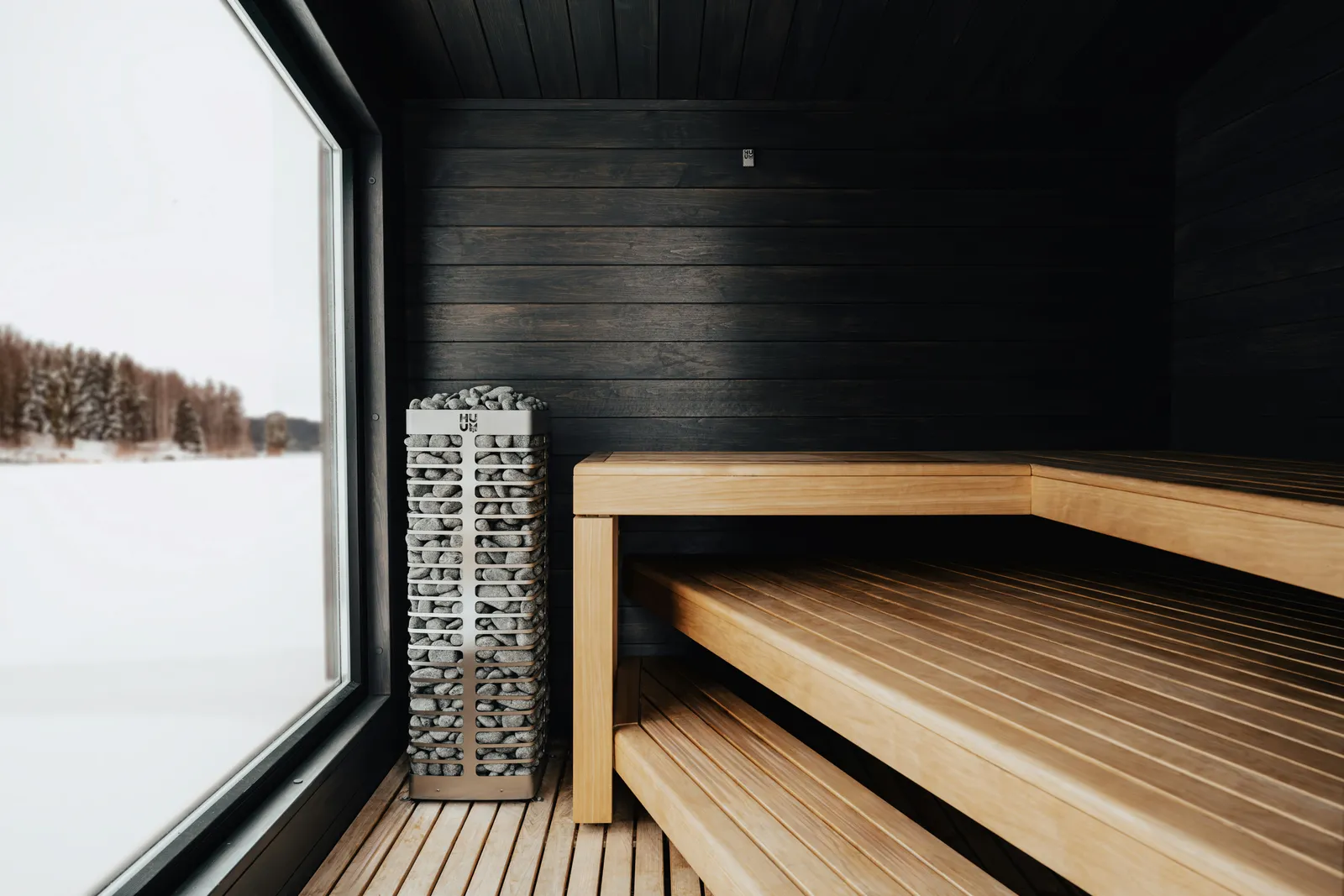
Heart rate commonly rises in a hot sauna, even while you are sitting still. That can be surprising the first time you see it on a watch. This post explains common patterns, the limits of wrist-based readings, and the signs that matter more than any number.
This is general information, not medical advice. If you have a heart condition, take heart medication, or are pregnant, talk to a doctor before making sauna a habit.
A normal sauna heart rate for a healthy adult is roughly 100 to 150 bpm, rising gradually through the round. A common Japanese rule of thumb is to leave at about twice your resting rate; Furolog uses 75% of heart rate reserve as a personalised reminder instead. What matters more than the peak is how you feel and how quickly the rate comes back down afterwards: in the research, heart rate is back at or below where it started within about 30 minutes of rest.
What is a normal heart rate in a sauna?
In reviews of Finnish-style sauna bathing, heart rate in a hot sauna typically rises to 100 to 150 bpm, from a resting 60 to 70. Measured sessions fill in the detail: in a 2024 study of young women, 20 minutes at 80°C gave a mean heart rate of about 103 bpm with peaks around 128, while 120°C pushed the mean to 121 and peaks to 145, and some participants fainted. A 2019 study that measured heart rate and blood pressure through a 25 minute sauna at 93°C found the cardiac load comparable to submaximal dynamic exercise at roughly 60 to 100 watts, about the effort of a brisk walk or an easy jog.
So a rough map for a healthy adult:
| Heart rate in the sauna | What it usually means |
|---|---|
| Under 100 bpm | Early in the round, lower bench, or a mild sauna |
| 100 to 130 bpm | Typical for a normal round |
| 130 to 150 bpm | Hot round, upper bench, after löyly, or long stay |
| Over 150 bpm | Time to get out for most people |
Those are population numbers. Yours will shift with age, fitness, hydration, and how hot the room is, which is why the next section matters more than the table.
Why your heart rate climbs when you are not moving
Heat has to leave your body somehow. Your body's main tool is skin blood flow: it dilates the vessels near the surface and pumps more blood through them so heat can radiate away, and in severe heat stress that flow can reach 6 to 8 litres a minute. That extra flow needs more cardiac output, and since stroke volume cannot rise much when you are sitting still, the heart compensates by beating faster.
The climb is gradual because your core temperature rises gradually; an early Japanese study described heart rate rising roughly in proportion to time spent in the sauna. Sweat adds a second effect: as you lose fluid, blood volume drops slightly, and the heart beats faster again to keep pressure up. That is why the last minutes of a long round, and the second and third rounds of a session, usually show a higher heart rate than the first few minutes did. In a study of four 10 minute rounds at 90°C with only 5 minute breaks, mean heart rate climbed from 98 bpm in the first round to 133 bpm in the fourth.
A sudden spike is different from the gradual climb. Standing up, a löyly pour, or walking to the door will produce a jump that settles within a minute. If a spike does not settle, that is a stronger signal than any single number.
The exit rule: about double your resting heart rate
A common Japanese rule of thumb, repeated across sauna blogs and facility guides, is to leave the sauna when your heart rate reaches roughly twice your resting rate. For someone resting at 60, that is 120 bpm. It is simple, and for most people it lands in the "typical round" band above. We have not found it in any association guideline, so treat it as folk wisdom that happens to work, not a safety standard.
The limitation is that it treats a 25 year old and a 65 year old the same. A better personal limit uses heart rate reserve, which is what Furolog does.
Heart rate reserve: a limit that is actually yours
Heart rate reserve (HRR) is the gap between your resting heart rate and your maximum. The Karvonen method sets targets as a percentage of that gap:
Target = resting HR + (max HR − resting HR) × percentage
Take a 35 year old with a resting heart rate of 55 and an estimated maximum of 185. Their reserve is 130 bpm. 75% of reserve is 55 + 130 × 0.75, about 152 bpm. 50% of reserve is 120 bpm.
Furolog uses 75% and 50% of heart rate reserve as product reference points. The first can remind you to check how you feel; the second helps describe the downward trend during recovery. They are not medical safety limits and do not confirm that you are ready for another round. Leave sooner if you feel unwell, and wait longer or stop for the day if you have not recovered comfortably.
For the watch to do this well it needs a realistic resting heart rate. Apple Watch measures one overnight, and Furolog reads it from Health. If your resting rate is wrong because you rarely sleep with the watch on, the 75% line will be wrong too.
What a good recovery looks like
Recovery is where the sauna pays off, and it is the number worth watching more than the peak.
In a 2019 study of sauna bathing and the autonomic nervous system, participants' heart rate had dropped below their pre-sauna value by the end of a 30 minute recovery, 68 bpm compared with 77 before, and heart rate variability measures had returned to near baseline. That dip below where you started is the "parasympathetic rebound", and it is the physiology behind the calm, heavy feeling Japanese sauna culture calls ととのう. The Japan Sauna and Spa Association textbook gives the same order of magnitude: pulse returns to normal 20 to 30 minutes after leaving the sauna.
On a chart it looks like this: a gradual climb during the round, a sharp drop in the first minute after you leave (faster still if you go into cold water), then a slower slide through the rest toward, and often below, your resting rate. Furolog classifies this curve into one of five recovery patterns so you can see at a glance whether today's session was a good one, a slow one, or one where you were probably dehydrated.
Reading your own sessions
A few things we have learned from watching a lot of sauna charts:
- Round one is your baseline. The first round of the day starts from a true resting state. Compare later rounds to it, not to each other.
- A rising floor is a warning. If your heart rate between rounds does not come back down to where it was after round one, you are accumulating heat or losing fluid. Drink, rest longer, or stop.
- Peak heart rate is not a score. A higher peak does not mean a better session. Recovery trends can be useful for comparing your own sessions, but they do not measure fitness by themselves.
- Beta blockers flatten the whole chart. In a trial of sauna bathing in coronary patients, many of them on beta blockers, heart rate at the end of a session was only about 96 bpm. If you take one, go by time and by how you feel, not by the numbers in this post.
- The watch can lie in the first minute after löyly. Sweat under the sensor produces spikes. Wait a minute before trusting a jump.
When to leave regardless of the number
Dizziness, nausea, tingling, a headache, or a heart that feels irregular are all reasons to leave now, whatever the watch says. Sit down outside the sauna, drink water, and do not go into cold water until you feel normal. If it happens more than once, see a doctor before your next session.
Read next: How long in the sauna, cold plunge, and rest? · Are sauna calories real? · Your first sauna: a beginner's guide
Sources
- Laukkanen JA, Laukkanen T, Kunutsor SK. "Cardiovascular and other health benefits of sauna bathing: a review of the evidence." Mayo Clin Proc. 2018;93(8):1111-1121. https://doi.org/10.1016/j.mayocp.2018.04.008
- Podstawski R, et al. "The influence of extreme thermal stress on the physiological and psychological characteristics of young women who sporadically use the sauna." Front Public Health. 2024;11:1303804. https://doi.org/10.3389/fpubh.2023.1303804
- Ketelhut S, Ketelhut RG. "The blood pressure and heart rate during sauna bath correspond to cardiac responses during submaximal dynamic exercise." Complement Ther Med. 2019;44:218-222. https://doi.org/10.1016/j.ctim.2019.05.002
- Charkoudian N. "Mechanisms and modifiers of reflex induced cutaneous vasodilation and vasoconstriction in humans." J Appl Physiol. 2010;109(4):1221-1228. https://doi.org/10.1152/japplphysiol.00298.2010
- Mizuta T, et al. "Physiological effect on the body in the sauna bath." Jpn J Phys Fitness Sports Med. 1975;24(3):101-107. https://doi.org/10.7600/jspfsm1949.24.101
- Podstawski R, et al. "Correlations between repeated use of dry sauna for 4 x 10 minutes, physiological parameters, anthropometric features, and body composition in young sedentary and overweight men." Biomed Res Int. 2019;2019:7535140. https://doi.org/10.1155/2019/7535140
- Karvonen MJ, Kentala E, Mustala O. "The effects of training on heart rate: a longitudinal study." Ann Med Exp Biol Fenn. 1957;35(3):307-315. https://pubmed.ncbi.nlm.nih.gov/13470504/
- Laukkanen T, et al. "Recovery from sauna bathing favorably modulates cardiac autonomic nervous system." Complement Ther Med. 2019;45:190-197. https://doi.org/10.1016/j.ctim.2019.06.011
- Japan Sauna & Spa Association (公益社団法人日本サウナ・スパ協会). https://www.sauna.or.jp/
- Debray A, et al. "Finnish sauna bathing and vascular health of adults with coronary artery disease: a randomized controlled trial." J Appl Physiol. 2023;135(4):795-804. https://doi.org/10.1152/japplphysiol.00322.2023
Quick answer
- Common pattern: heart rate rises during heat and falls during recovery, but the numbers vary widely.
- Why: skin blood flow for cooling, then fluid loss. Not exercise, but the heart cannot tell the difference.
- Exit rule: about double your resting heart rate (a common rule of thumb), or 75% of heart rate reserve, which is the personalized version Furolog alerts on.
- Recovery: back below 50% HRR before the next round, and ideally below your resting rate within 30 minutes.