Furolog
Saunatonttu: the sauna elf, the rules he enforces, and why they are mostly good advice
Every Finnish sauna has a small guardian living behind the stove. Where the belief comes from, what he punishes, what you leave him on Christmas Eve, and why his rules read like a safety checklist.
Updated September 4, 2026
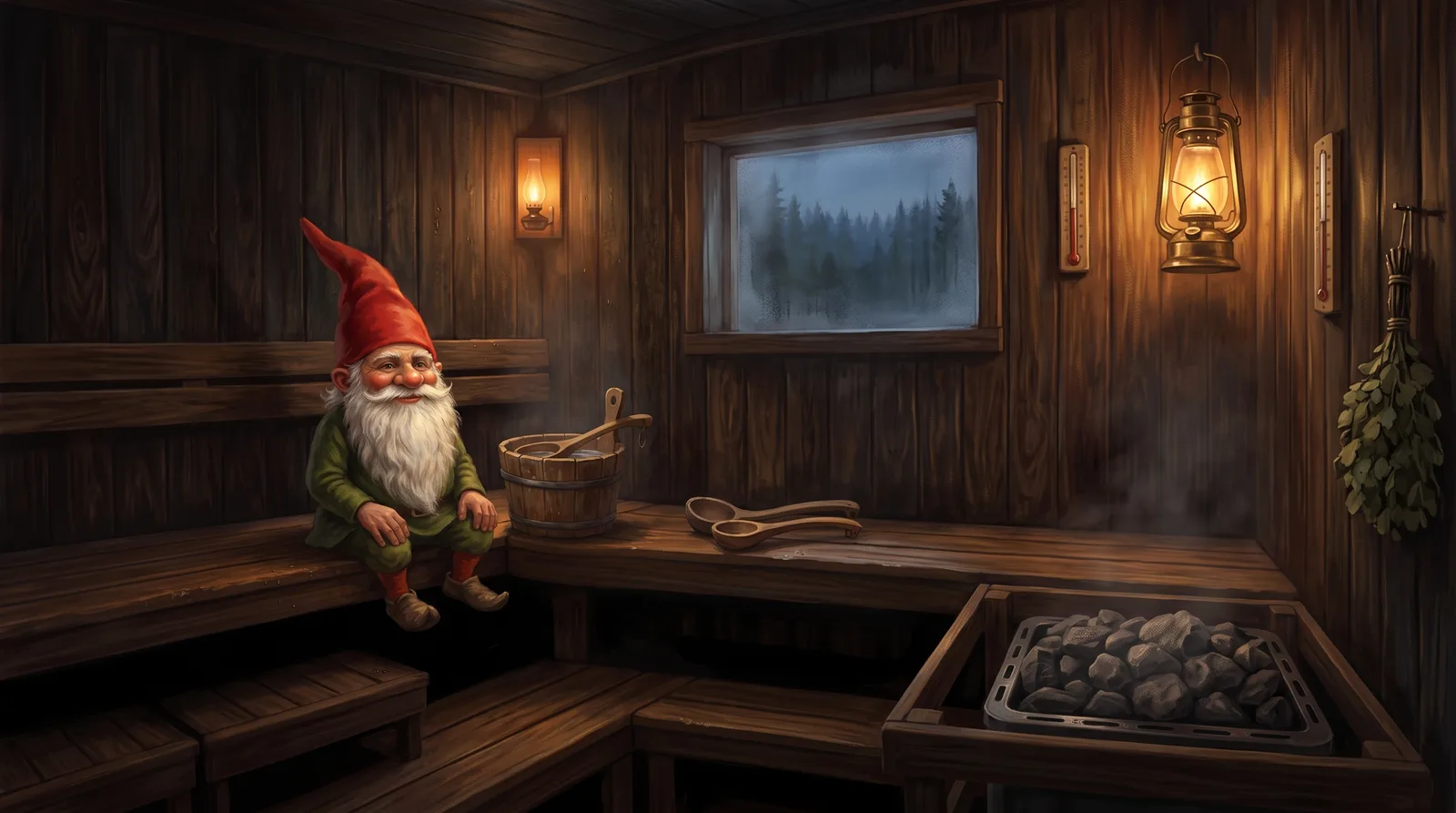
Somewhere in the gap between the kiuas and the wall of every Finnish sauna, in the shimmer of heat above the stones, there lives a small old man. He has been there since the first fire was lit in the room. He likes quiet, clean benches, and the last löyly of the evening. He dislikes shouting, swearing, beer in the hot room, and people who stay too late. He is the saunatonttu, and although almost nobody in Finland believes in him anymore, almost everybody behaves as if they do.
The saunatonttu is the guardian spirit of a Finnish sauna, said to live behind the kiuas. He wants quiet, no drinking in the heat, no bathing late at night, a clean room, and the last löyly of the evening thrown for him. On Christmas Eve the family bathes in the afternoon and leaves him the sauna. Read together, his rules are a sauna safety code with a small angry man attached to it.
What is a saunatonttu?
The word is borrowed. Tonttu comes from the Swedish tomtegubbe, the little man of the homestead, and it arrived in Finnish with the farms and villages it describes. The idea underneath it is older and Finnish: the haltija, a guardian spirit attached to a place. When Finns stopped moving through the forest and settled on owned land, every building on the farmstead got its own. The house had a kotitonttu, the barn a navettatonttu, the mill a myllytonttu, and the sauna, the most important building after the house itself, had a saunatonttu.
How one comes to exist has several answers in the folklore, and the sauna's is the tidiest. The guardian was the first person to light a fire in the room, or the one who built it, or in darker versions the first person to die there. This is why the first heating of a new sauna was a ritual and not a chore: it created the spirit that would live in it. Families who built a new sauna are said to have carried ash from the old stove to the new one so the tonttu would move with them, and the tradition has stories of a guardian seen walking from an old sauna to a new one, which tells you people took the move seriously.
The oldest written summaries of the Finnish household spirits give the tonttu one job: governing the household's conduct. That is the whole description, and it is enough.
What he looks like
Rarely seen, and seeing him was a bad sign, because he only showed himself when the sauna was being neglected. Where he was described, he was a small, bearded man in grey, in some regional tellings one-eyed. Stranger versions have him black, flat, and living in the stove itself. The modern red-capped gnome on a tea towel is the Christmas tonttu, a nineteenth-century Scandinavian import who took over the look and, over time, borrowed the sauna elf's job as well.
The rules of saunarauha
Saunarauha means sauna peace, and the tonttu was its enforcer. Finnish folklore is consistent about what he would not tolerate:
- Noise, quarrelling, shouting, whistling, swearing.
- Drinking in the hot room, eating in the hot room.
- Spitting, urinating, breaking wind on the benches.
- Slamming doors, leaving the door open so the heat escaped.
- Using the sauna as a storeroom.
- Treating the vihta carelessly. It should be hung up properly, not left on the bench.
- Bathing late at night. The evening belonged to the tonttu and, further back, the night belonged to the dead.
- Bathing on holy days.
The punishments were not small. The story that every Finnish schoolchild knows is in Aleksis Kivi's Seven Brothers, from 1870: a servant girl who went to the sauna alone on Saturday evenings, late, after everyone else. One night she did not come back, and in the morning her skin was found hanging in the sauna, flayed and left as a warning. The brothers tell it to each other in the dark, and it works on them exactly as it was meant to.
Read that list again and notice what it is. Do not drink in the heat. Do not stay too long. Keep the room ventilated. Look after your equipment. Do not go in alone at the end of the day when nobody will notice if you pass out. Finnish folklore had a sauna safety code centuries before anyone measured a heart rate, and it attached the rules to a small angry man because that is what makes people follow rules. The household guardian in the wider tradition was also credited with raising the alarm about an unconscious bather, which is a fair description of what a heart rate alert does.
What you leave him
He was paid in kind. A little water left in the bucket. The vihta rinsed and hung up. A clean, swept room. Food and drink left outside the door, bread or a small beer, never inside. And above all the last löyly: the final ladle of water thrown on the stones before you leave, so the room is full of steam for him after you go. Some households are said to have thrown beer on the stones as a sacrifice for the grain harvest, which anyone who has tried it will tell you is dangerous and smells terrible. Do not do this. It is bad for the stones, worse for the kiuas, and the smell of burnt sugar in a 90°C room is not a blessing.
The most important offering was time. You finished early and left the evening to him. That is the custom that survives.
Christmas Eve
The Christmas Eve sauna is one of the most widely kept traditions in Finland. Traditionally the whole family bathes on Christmas Eve in the afternoon, before Christmas dinner, and treats are left for the saunatonttu. The reason for the early hour is the tonttu. After the family has bathed, the sauna is left warm, the door is closed, water is left in the bucket, a vihta is left by the stove, and the room is his for the evening. Older folklore describes the same thing for the ancestral spirits: the sauna left dark and warm, and everyone keeping away from it after dusk.
It is the one night of the year the custom is still observed in full, and the reason it is still observed is that it is a lovely thing to do. You sit down to dinner clean, calm, and with the sauna quietly steaming outside for whoever is in there.
The tonttu in Japan
The word has crossed to Japan almost intact. トントゥ turns up on sauna hats and towels, as carved wooden figures in Finnish-style facilities, and on Sauna Ikitai, the country's largest sauna review site, where it is the name of the points users collect for logging visits. A trace of the original meaning survives in that: you earn tonttu by going to the sauna and looking after the community. The Finnish elf would approve, though he would want you to log the visit after you have left the room, not on the bench.
What Furolog thinks of the tonttu
Most of the tonttu's rules are also Furolog's. Alcohol in the heat is the leading avoidable factor in sauna deaths in Finland: a forensic study of Finnish sauna deaths from 1990 to 2002 found about half of the dead had been drinking, and a review of sauna risks lists hypotension, arrhythmia, and sudden death among what alcohol in the heat invites. That is the subject of who should skip the sauna. Staying too long is what the round-by-round guidance in how long in the sauna, cold plunge, and rest is about. Going in alone, late, tired, is the situation where a heart rate alert on your wrist is most useful, and the reason the watch is worth wearing in the room at all is covered in Apple Watch in the sauna.
The one rule he gets wrong for modern life is the bit about not going in after dark. A late session is fine. Just leave the beer for the porch afterwards, throw the last löyly before you go, and hang up the vihta.
Read next: Finnish sauna terms · Löyly: the steam of a Finnish sauna · Kiuas: the sauna stove
Sources
- Visit Jyväskylä Region. "Christmas sauna traditions in Finland."
- Kivi A. Seitsemän veljestä (Seven Brothers). 1870. Project Gutenberg.
- Sauna Ikitai.
- Kenttämies A, Karkola K. "Death in sauna." J Forensic Sci. 2008;53(3):724-729.
- Hannuksela ML, Ellahham S. "Benefits and risks of sauna bathing." Am J Med. 2001;110(2):118-126.
Quick answer
- Saunatonttu: the guardian spirit of a Finnish sauna. A small, bearded, in some tellings one-eyed man living behind the kiuas, born from the first fire lit in the room.
- His rules: quiet, no drinking, no late bathing, door closed, vihta hung up, room left clean. Read as a whole, it is a safety code.
- What you leave: the last löyly, water in the bucket, a rinsed vihta, and the evening to himself. On Christmas Eve, the whole evening.
- In Japan: トントゥ, on hats, towels, and as the points on Sauna Ikitai.