Furolog
Finnish sauna terms: the vocabulary from löyly to avanto, and what each one looks like on your heart rate
Kiuas, löyly, vihta, lauteet, avanto, saunatonttu. A glossary of the words you will hear in a Finnish sauna, how to say them, what they mean, and the Japanese sauna word that comes closest.
Updated September 4, 2026
Finnish gave the world exactly one word that everyone uses, and it is sauna. The rest of the vocabulary stayed at home, which is a pity, because Finnish has a precise word for almost everything that happens between the changing room and the porch. This is a glossary of the ones you will actually hear, with a note on pronunciation, what the thing is, and where it fits in the cycle. The longer posts on each are linked as you go.
The short version: löyly is the steam from water on the stones, kiuas is the stove, lauteet are the benches, vihta (or vasta) is the birch whisk, vilvoittelu is cooling off, avanto is the hole in the ice, and saunatonttu is the elf who wants the room left tidy. Say every letter, stress the first syllable, and wish people hyviä löylyjä on the way in.
One pronunciation rule covers most of it: every letter is said, stress is always on the first syllable, and a double letter is held twice as long. Sauna is SOW-na, rhyming with cow, not SAW-na.
The room and what is in it
Sauna. The room, the building, and the activity. Finnish also uses it as a verb stem: saunoa is to sauna, saunominen is the doing of it. Nobody says "take a sauna" in Finnish. You simply sauna.
Kiuas (KEE-oo-as). The stove, wood or electric, with the stones on top. It is the thing Finns judge a sauna by before anything else, and it is why two rooms at the same temperature can feel completely different. Full explainer in Kiuas: the sauna stove.
Kiuaskivet (KEE-oo-as-KEE-vet). The sauna stones. Typically dense volcanic rock such as olivine diabase, chosen because it holds heat and does not crack. Never pour anything but water on them, and never a beer.
Lauteet (LOW-teh-et). The benches, always plural. The upper bench is ylälaude, the lower is alalaude. The heat difference between them is real: the Japan Sauna and Spa Association's textbook puts head height on the upper bench at about 90°C against about 70°C on the lower bench in a typical room, and on a heart rate chart the upper bench shows as a steeper climb. If you want an easier session, sit lower. Nobody minds.
Kiulu (KEE-oo-loo) and kauha (KOW-ha). The bucket and the ladle. Wooden by tradition, plastic in most public saunas, and one of the two is the object people mean when they say "the sauna" is missing something.
Pefletti (PEF-let-ti). The disposable or reusable seat cover you sit on in a public sauna. Bring your own or take one from the stack by the door. Sitting bare on a public bench is the fastest way to be quietly disliked.
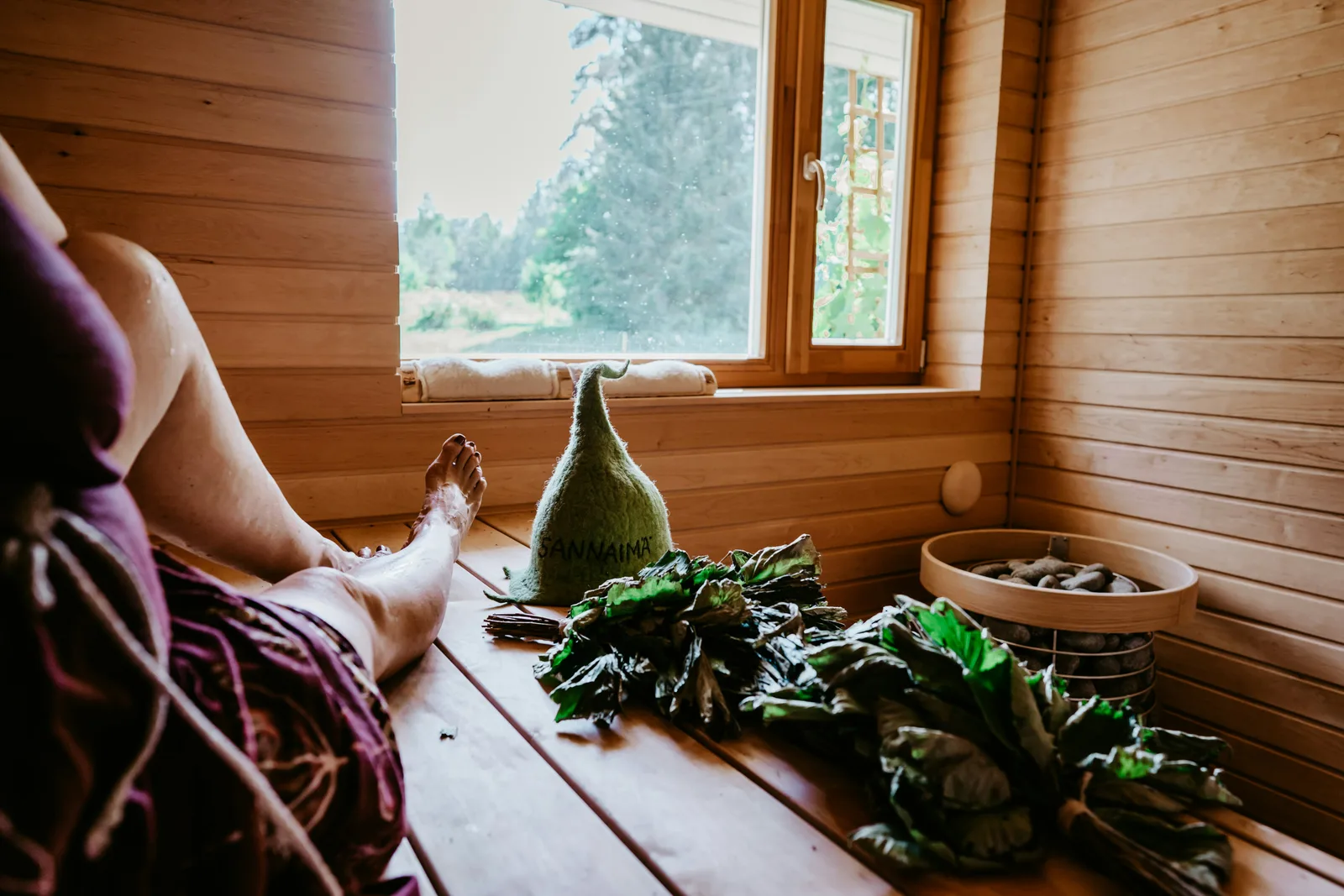
Saunahattu (SOW-na-hat-tu). The felt sauna hat, which keeps the head cooler than the room and lets you stay longer at a given temperature. Familiar in Japan as サウナハット, where it has become a fashion object in a way it never quite did in Finland.
The heat
Löyly (LEU-loo, with a rounded "eu" as in French "peu"). The steam that rises when water hits the stones, and the single most important word in the language of sauna. UNESCO's description of Finnish sauna culture calls it "the spirit or steam released by casting water onto a stack of heated stones", and the double meaning is old. Everything about the quality of a sauna is described through its löyly: soft, hard, wet, dry, good, bad. The full story is in Löyly: the steam of a Finnish sauna.
Heittää löylyä (HAY-tah LEU-loo-ah). To throw löyly, which is what you say for ladling water onto the stones. Ask before you do it in a shared room, and expect the person nearest the kiuas to be the one who throws.
Hyviä löylyjä! (HOO-vee-ah LEU-loo-yah). "Good löyly!" The thing you say to someone heading into the sauna, and the closest Finnish has to a sauna greeting. Answer with kiitos, thanks.
Savu (SA-vu). Smoke, as in savusauna, the smoke sauna without a chimney that is heated for hours and then aired out before anyone goes in. The oldest form and, for most Finns, the best. It is the first entry in Types of Finnish sauna.
Puusauna and sähkösauna (POO-sow-na, SAH-keu-sow-na). Wood-heated and electric sauna. The wood one is what people mean when they say a cottage sauna. The electric one is what is in most apartments.
The whisk
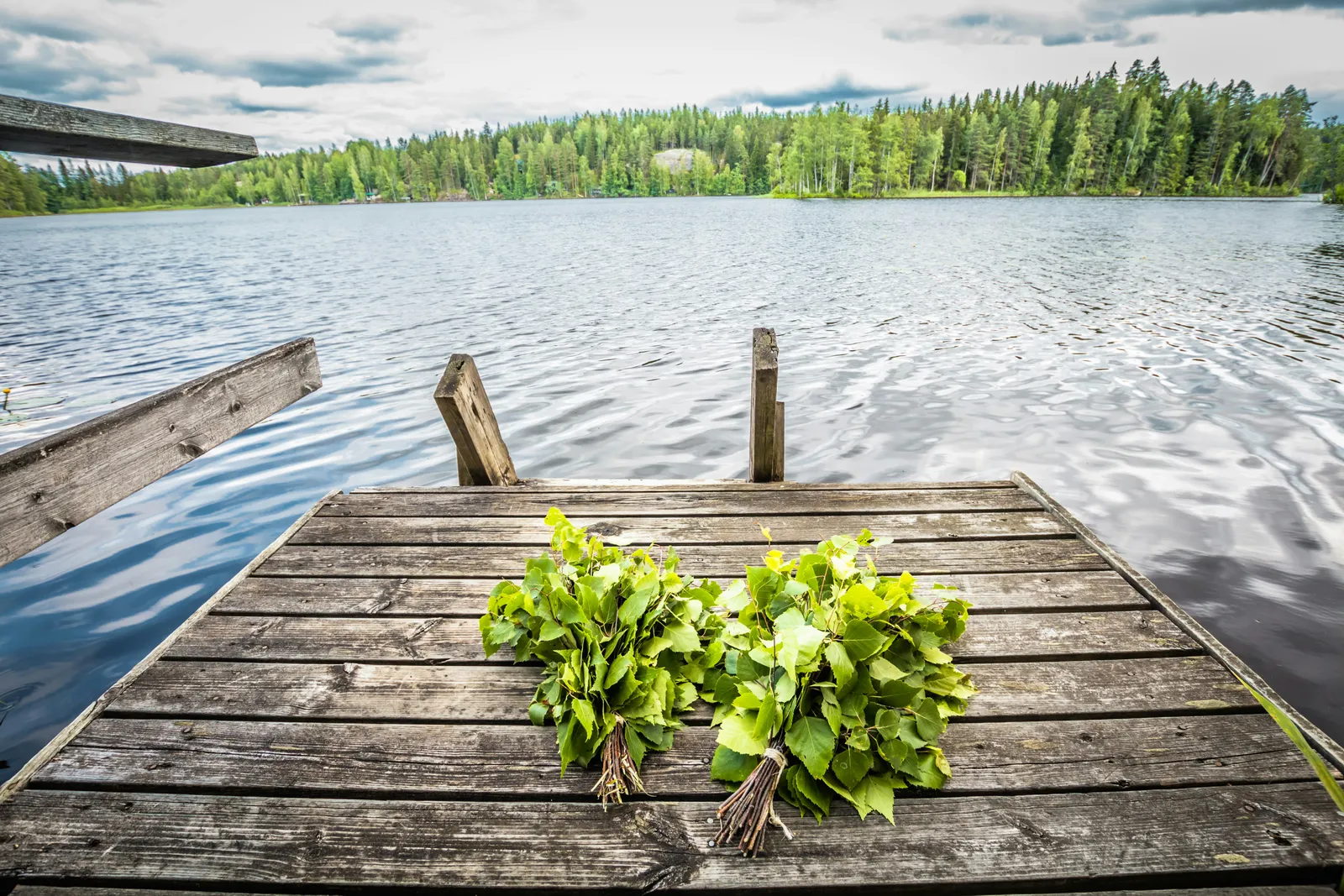
Vihta (VIH-ta) in the west, vasta (VAS-ta) in the east, though Kotus, the Institute for the Languages of Finland, notes that vasta is also widely used in Central and North Ostrobothnia, so the split is not clean. A bundle of young birch branches, soaked and used to slap the skin in the heat. Both words are standard Finnish, and the two have been arguing with each other for centuries. Everything about it, including why your watch would rather you took it off for this part, is in Vihta: the birch whisk.
Vihtoa (VIH-to-a). To use the whisk. The session with one is vihtominen.
The cold
Vilvoittelu (VIL-voy-teh-lu). Cooling off. The verb is vilvoitella. Standing on the porch, sitting on the steps, walking to the lake: the part between rounds where the heart rate comes down. Japanese sauna culture has the exact same concept as 外気浴, and the fact that both cultures gave it a name tells you how central it is. On a Furolog chart it is the descending slope after every peak, and it is where the recovery patterns are decided.
Avanto (A-van-to). A hole cut in lake or sea ice. Avantouinti is swimming in it, the winter version of the cold plunge, and the sharpest heart rate event you will ever log: the first seconds bring the gasp and heart rate jump of the cold shock response, then a fall that goes on for minutes. The health claims made for winter swimming are still debated, the risks are not. The safety section of How long in the sauna, cold plunge, and rest applies doubly.
Järvi (YAR-vi). Lake. Most cottage saunas stand within twenty steps of one, which is why the lake is the default cold plunge for half the country from June to September.
Talviuinti (TAL-vi-oo-in-ti). Winter swimming, the broader hobby that avanto belongs to, with its own clubs and its own heated changing rooms at the water's edge.
Around the sauna
Saunaolut (SOW-na-o-lut). Sauna beer, drunk on the porch after the last round, not during. The tradition and its one real risk are in Saunaolut: the sauna beer. The Japanese counterpart is オロポ, which replaces electrolytes rather than adding a lager on top.
Saunamakkara (SOW-na-mak-ka-ra). Sauna sausage, wrapped in foil and cooked on the stones or the stove while you sit. The smell of it is part of the smell of a cottage evening. Cook it on the side of the kiuas, never on the stones themselves.
Saunavuoro (SOW-na-voo-o-ro). Your sauna slot. Apartment buildings with a shared sauna assign each household a weekly hour, and it is not lightly given up. In public saunas the same word covers the schedule, with naistenvuoro for women's hours and miestenvuoro for men's.
Juhannussauna and joulusauna (YU-han-nus-sow-na, YO-lu-sow-na). The midsummer sauna and the Christmas sauna, the two sessions of the year nobody skips. Midsummer is the fresh vihta and the lake at midnight. Christmas Eve is the whole family in turns, in the afternoon before dinner, in an old order that predates the holiday itself.
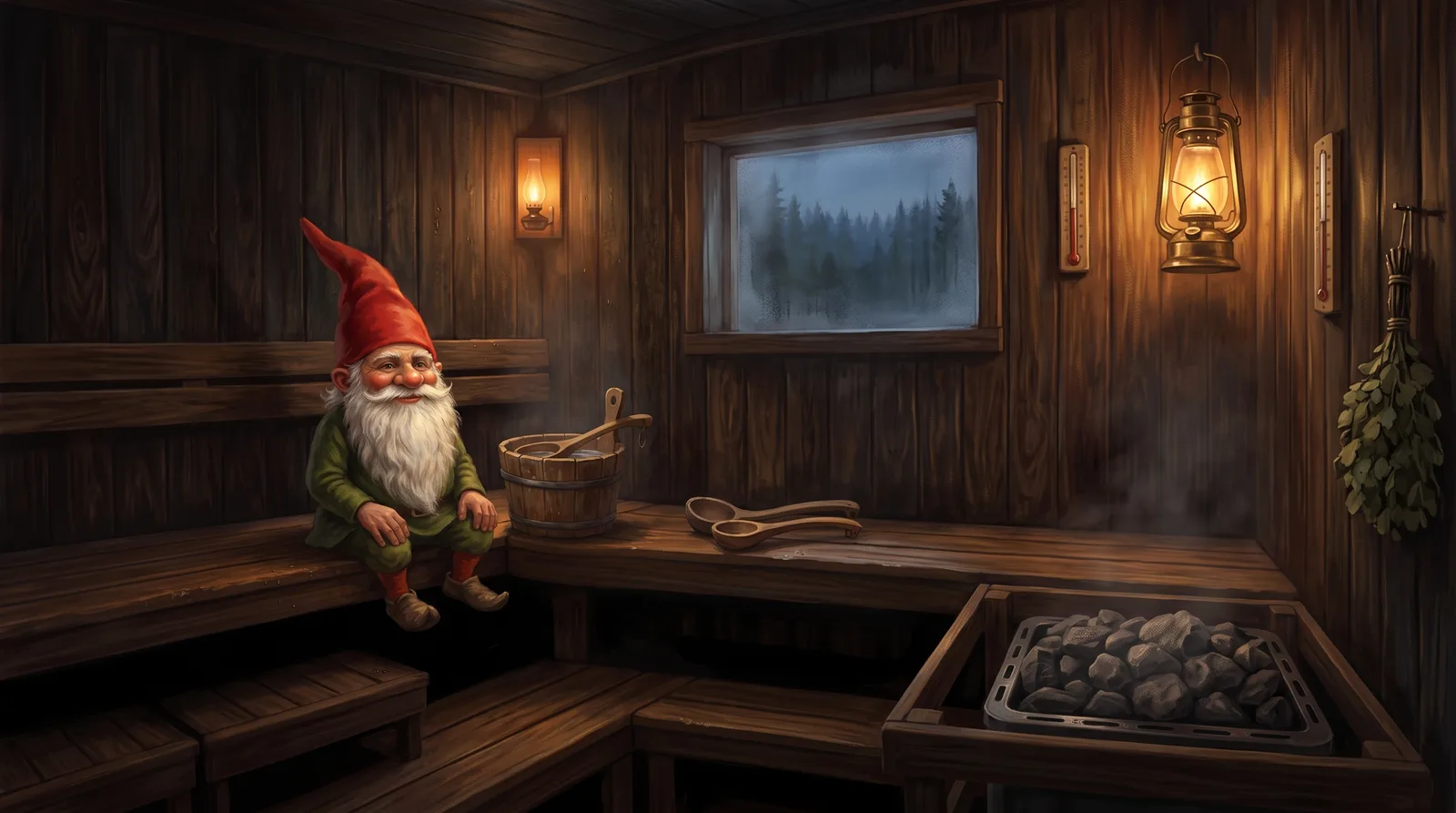
Saunatonttu (SOW-na-ton-tu). The sauna elf, a small guardian spirit who lives behind the kiuas and keeps the sauna in order. He has a post of his own. He is left the last löyly of the evening and a clean room. Behaving badly in the sauna, swearing, drinking too much, staying too late, annoys him, and old stories say he burns the sauna down. The practical translation is that a sauna is a quiet place and you should leave it as you found it.
Löylynhenki (LEU-loon-hen-ki). The spirit of the löyly, an older idea than the elf, from a time when löyly and breath were the same word. It is why the sauna was a place for births (most Finnish births once took place at home, often in the sauna) and why it is still a place where Finns lower their voices.
How do Finnish sauna terms map to Japanese sauna words?
The two cultures arrived at the same ritual from opposite ends of the world, and the vocabulary shows it. Where a term has a direct counterpart it is listed. Where it does not, the gap is interesting in itself.
| Finnish | Japanese | What it means |
|---|---|---|
| Löyly | ロウリュ | Steam from water on the stones. Japan borrowed the word directly. |
| Kiuas | サウナストーブ | The stove. Japanese has no single word for it. |
| Vihta / vasta | ヴィヒタ | The birch whisk. Borrowed, and mostly known from Finnish-style facilities. |
| Vilvoittelu | 外気浴 | Cooling off between rounds. Both cultures named it. |
| Avanto | 水風呂 (winter lake version) | The cold plunge. Japan built a tub, Finland cut a hole in the ice. |
| Saunaolut | オロポ | The after-sauna drink. Beer versus electrolytes. |
| Saunahattu | サウナハット | The felt hat. Japan made it fashionable. |
| Saunominen | サ活 | The hobby of going to the sauna, as a practice. |
| Hyvä olo | ととのう | The calm after the cycle. Finnish just says "a good feeling". Japanese made it a verb. |
| Saunatonttu | (none) | The sauna elf. Japan has no equivalent, which is a shame. |
The one word Japan has that Finnish lacks is ととのう. Finns feel it, and have felt it for a couple of thousand years, but never gave it a name beyond "I feel good". If you want to see what it looks like as a number, it is the recovery curve on a Furolog chart falling back to resting after the last round.
What the vocabulary tells you about the cycle
Notice that the words cluster around exactly the three phases Furolog tracks. Löyly, kiuas, and lauteet are the heat. Vilvoittelu, avanto, and järvi are the cold and the rest. Saunaolut, makkara, and the porch are what comes after. Finnish did not have to invent the sauna cycle. It grew a word for each part of it. For what those phases do to the body, start at Sauna heart rate: what is normal, and for whether your watch is happy in the room at all, Apple Watch in the sauna.
Read next: Löyly: the steam of a Finnish sauna · Famous saunas in Finland · Saunatonttu: the sauna elf
Sources
- UNESCO. "Sauna culture in Finland." Representative List of the Intangible Cultural Heritage of Humanity, 2020.
- Institute for the Languages of Finland (Kotus). "Vasta ja vihta."
- Finnish Sauna Society. "A child in the sauna."
- Japan Sauna & Spa Association (公益社団法人日本サウナ・スパ協会).
- Visit Jyväskylä Region. "Christmas sauna traditions in Finland."
- Tipton MJ. "The initial responses to cold-water immersion in man." Clin Sci (Lond). 1989;77(6):581-588.
- Espeland D, de Weerd L, Mercer JB. "Health effects of voluntary exposure to cold water: a continuing subject of debate." Int J Circumpolar Health. 2022;81(1):2111789.
Quick answer
- Löyly: the steam. Kiuas: the stove. Lauteet: the benches. Vihta: the birch whisk.
- Vilvoittelu: cooling off, the Finnish 外気浴. Avanto: the ice hole, the winter cold plunge.
- Saunaolut: the beer after. Saunatonttu: the elf who wants the room left tidy.
- Say it: every letter, stress on the first syllable, SOW-na not SAW-na. And wish people hyviä löylyjä on the way in.