Furolog
The types of Finnish sauna, from smoke sauna to the one in every apartment
Finland has about three million saunas for five and a half million people. Here are the kinds you will actually meet, how each one feels, and how they compare with the Japanese sauna you may be used to.
Updated September 4, 2026
Sauna is Finnish enough that UNESCO put Finnish sauna culture on its list of intangible cultural heritage in 2020, counting 3.3 million saunas for 5.5 million people; the Finnish Sauna Society notes it was the first Finnish tradition on the list. It is also ordinary enough that most apartment blocks have one and most families have another at the summer cottage. The word covers several quite different rooms. Here they are, roughly from oldest to newest.
The main types are the smoke sauna (savusauna, chimneyless and the oldest), the wood-heated cottage sauna (puusauna), the electric apartment sauna (sähkösauna), and the public sauna, from 1906 bathhouses to seaside architecture. Add the avanto, a hole in the ice, and any of them becomes a winter swimming sauna. Typical temperature is 70 to 90°C with löyly thrown by hand, softer and more humid than the dry 90°C rooms common in Japan.
Smoke sauna (savusauna)
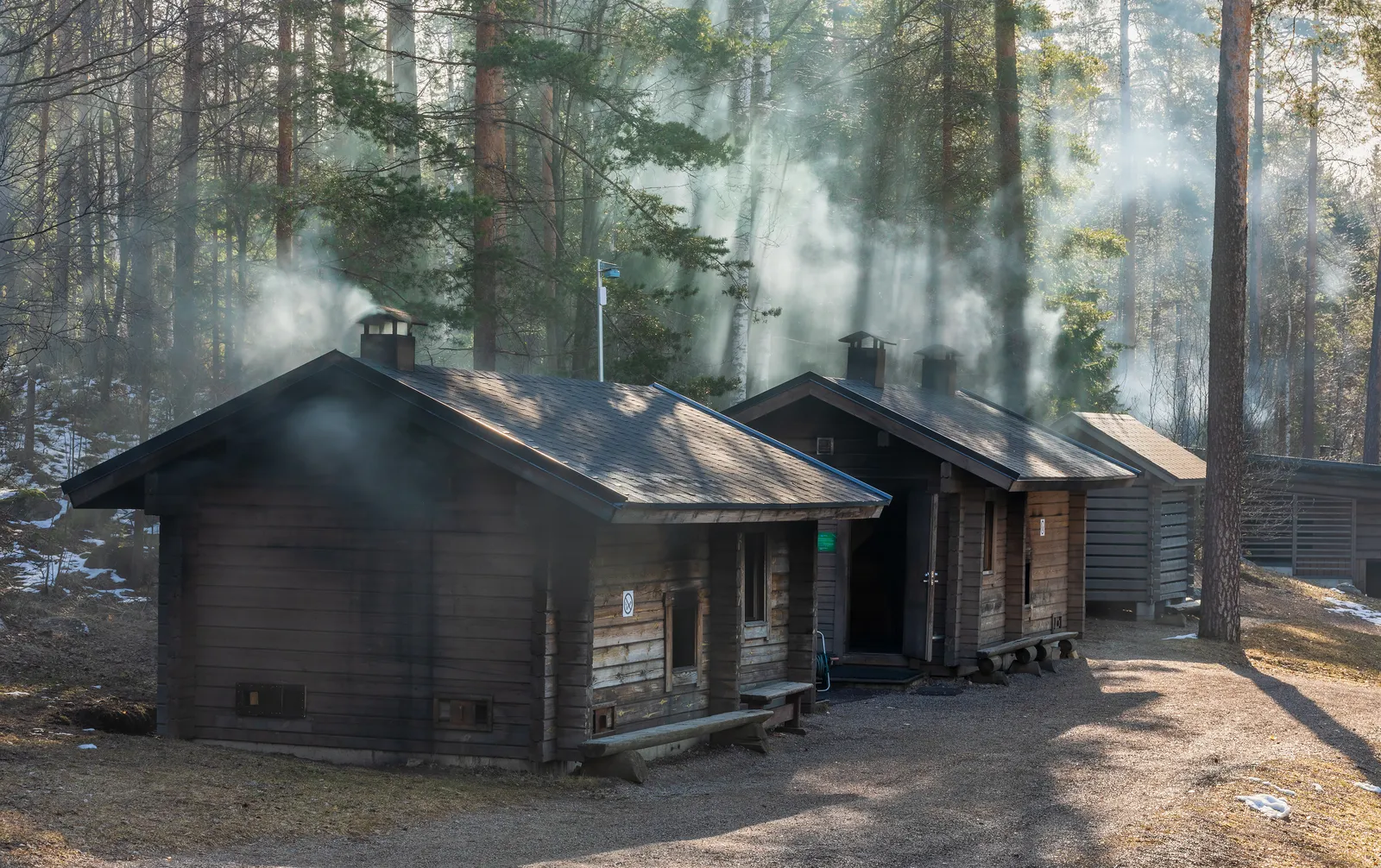
The original. A log room with a large chimneyless stove, fired for most of a day until the stones hold enough heat, then aired out and used as the stones cool. Dark, soft, cooler than a wood sauna, smelling of tar and smoke. The gentlest heat and the longest sessions. Rare, labour-intensive, and the one to seek out if you only get to try one thing in Finland.
Wood-heated sauna (puusauna)
The cottage sauna, and for most Finns the definition of the real thing. A wood stove with a chimney, heated for an hour or two, a lake or the sea outside the door. 70 to 90°C, löyly thrown by hand, cooling off on the porch or in the water between rounds. Most are small, seating four to eight, and the ritual of heating one is half the point. If a Finn invites you to their mökki, this is what you are being invited to.
Electric sauna (sähkösauna)
Where most sauna bathing in Finland actually happens: a small room in the apartment, often off the bathroom, with an electric heater. Switched on half an hour before, used for twenty minutes, switched off. Nothing romantic about it, and Finns use it several times a week the way other people use a bath. Quality depends entirely on the heater and its stone mass, as explained in the kiuas post.
Apartment blocks also usually have a shared sauna in the basement, bookable by the hour, with a weekly "lenkkisauna" evening when it is heated for everyone.
Public sauna (yleinen sauna)
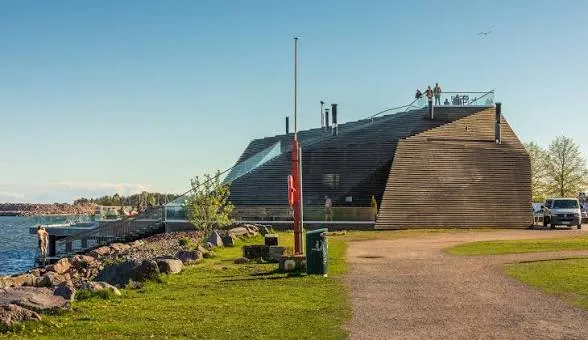
The neighbourhood bathhouse, which nearly died out in the late twentieth century and has come back strongly. Old ones like Rajaportti in Tampere (1906) and Kotiharju in Helsinki (1928) are wood-heated, cheap, and full of regulars. New ones like Löyly and Allas in Helsinki are architecture, seaside, and mixed, with swimsuits. In between are volunteer-run places like Sompasauna, free, unstaffed, and always open. See famous saunas in Finland for the list.
Ice swimming sauna (avantosauna)
Any sauna next to a hole cut in lake or sea ice becomes one of these in winter. The sauna is the warm-up; the avanto, the ice hole, is the point. Water just above freezing, a ladder, a few breaths in, back to the heat. Swimming clubs run these all winter, often with a proper wood sauna and a membership fee small enough to be a rounding error.
For anyone tracking it: an avanto is the most extreme cold plunge you will ever log. The first seconds bring the cold shock response: a gasp, fast breathing, and a jump in heart rate and blood pressure, and it is that response, not the cold itself, that makes ice water dangerous for anyone with a heart condition (review of the hazards and benefits). Then heart rate falls, and the rebound afterwards is the best example of the "reset" feeling there is. The health claims made for winter swimming are still debated; the risks are not. See who should skip the sauna.
Mobile, tent, and floating saunas
Finns will build a sauna into anything: a trailer, a tent with a stove, a raft, a boat, a bus, a phone box. Tent saunas are common at festivals and winter events. Floating saunas on lakes let you step from the bench into the water. These are as much a joke Finns enjoy as a tradition, and they are all real saunas with real löyly.
Infrared cabins
Not a sauna, by Finnish reckoning. No stones, no löyly, a much cooler cabin warmed by radiant heat. Finns will be polite about it and then tell you it is a heat lamp. The body agrees: in a 2025 comparison of heating methods, 45 minutes in a far-infrared cabin raised core temperature by 0.0°C, against 0.4°C for three 10 minute rounds at 80°C in a sauna, and a review of sauna physiology describes the circulatory response to a hot sauna as resembling moderate to high intensity exercise, which an infrared cabin does not reproduce.
How do Finnish saunas differ from Japanese saunas?
If you know sauna from Japan, the rooms are the same idea and the customs are different.
| Finland | Japan | |
|---|---|---|
| Typical temperature | 70 to 90°C, humid with löyly | Hot and dry, most rooms between 50 and 100°C, löyly increasingly common |
| Stove | Wood or large-stone electric | Electric or gas, often small stone mass |
| Cold | Lake, sea, snow, or avanto | 水風呂 cold tub, kept cold year-round |
| Rest | Porch, terrace, outside (vilvoittelu) | 外気浴 rest area, chairs |
| Dress | Nude in traditional and single-sex saunas; swimsuit or towel acceptable in mixed public ones | Nude, single-sex, always |
| Rounds | Fewer, longer, unhurried | 2 to 3 sets, often timed |
| Talking | Quiet, some conversation | Quiet, usually silent |
| Sauna hat | Common | Increasingly common, borrowed from Finland |
The Japanese sauna cycle of サウナ, 水風呂, 外気浴 is a formalized version of what a Finn does at the cottage without naming it. The main practical difference is the water: Finland cools you in a lake that is mild in summer and barely above freezing in winter, Japan in a tub kept at the same cold temperature all year. Both work. The watch shows the same drop.
Read next: Kiuas: the sauna stove explained · Vihta: the birch whisk in the sauna · Finnish sauna terms
Sources
- UNESCO. "Sauna culture in Finland." Representative List of the Intangible Cultural Heritage of Humanity, 2020.
- Finnish Sauna Society. "Sauna and Unesco."
- Visit Finland. "Your guide to Finnish sauna."
- Rajaportin sauna (Pispalan saunayhdistys).
- Kotiharjun sauna.
- Sompasauna.
- Tipton MJ. "The initial responses to cold-water immersion in man." Clin Sci (Lond). 1989;77(6):581-588.
- Tipton MJ, Collier N, Massey H, Corbett J, Harper M. "Cold water immersion: kill or cure?" Exp Physiol. 2017;102(11):1335-1355.
- Espeland D, de Weerd L, Mercer JB. "Health effects of voluntary exposure to cold water: a continuing subject of debate." Int J Circumpolar Health. 2022;81(1):2111789.
- Atencio JK, et al. "Comparison of thermoregulatory, cardiovascular, and immune responses to different passive heat therapy modalities." Am J Physiol Regul Integr Comp Physiol. 2025;329(1):R20-R35.
- Heinonen I, Laukkanen JA. "Effects of heat and cold on health, with special reference to Finnish sauna bathing." Am J Physiol Regul Integr Comp Physiol. 2018;314(5):R629-R638.
- Consumer Affairs Agency of Japan. "サウナ浴での事故に注意" News release, 5 Jun 2024.
Quick answer
- Smoke sauna: oldest, softest, rarest. Seek it out.
- Wood-heated: the cottage standard, the real thing.
- Electric: the apartment standard, the everyday thing.
- Public: old wooden bathhouses and new seaside architecture, both worth a visit.
- Avanto: sauna plus a hole in the ice. The most extreme cold plunge there is.